Changes in the Chicken Yard

We came home from vacation to some great excitement in our chicken yard.

There’s been a lot of changes out there this spring. Our two three-year old hens never started laying again this spring and both ended up dying from internal issues. But we already had moved our spring chicks outside with them, and with our two one-year old bantams out there as well, I finally panicked:

There were too many chickens in our backyard!
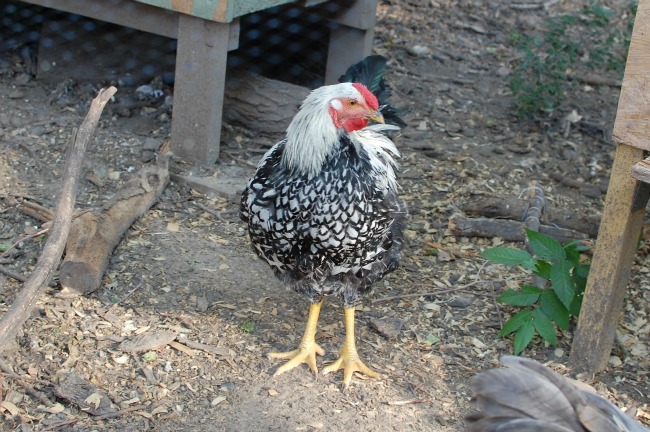
But as it turned out, two of the new chicks were growing up to be extremely beautiful.

And of course, especially beautiful chickens, are actually roosters.  So we ended up dispatching those two.

Our two red chickens were looking suspiciously different, with one having a much more pronounced comb.  But we’re now satisfied that they are both hens, and their differences are simply from their two breeds.  That was a relief, especially since we paid for more expensive eggs this year to be “sure” they were all hens.

So in the end, five new chicks only ended up adding one to our total flock size.  That felt much better for our little back yard.

We hired a chicken-sitter to watch our flock while we were away, and when we came back. . .

The chickens were laying!  The small pale eggs are from our bantams, which were already laying but the brown and (eek!) blue eggs are from this springs’ chicks.

I am so excited about the Ameraucana eggs.  I’m sad that one of my Ameraucanas was a rooster, but I’m happy to have at least one.  I really wanted to get an Ameraucana last year, but those teensy bantam chicks put a spell on my and we brought them home instead.

These eggs are the great joy of having a backyard flock.  Life and food are better with variety.

Chickens and Gardens

We always have to keep our chickens locked up quite a bit more than normal while our vegetable garden is young. Most of the time we prefer to let the girls have a lot of “free ranging.”

They scratch around quite a bit, but then spend lot’s of time in dirt holes they make under our shrubs.  They love to be out in the yard.

But most of the time we try and keep the chickens away from the vegetable garden, because they like to eat tender young greens, and generally trample over everything on their way.   But our chickens do have one important garden job: grub duty. As I turned the soil in our front yard beds last week, I had my boys break up and clods and look for white grubs.


They are the sick-looking younger (larval/pupae? I’m not really an entomologist–just a beekeeper) versions of the noisy summer cicada. They eat the roots of grass–it that’s what they’re under– and make brown, dead areas, and their juicy presence attracts moles. So as the boys searched for the little grubs, we collect them and then take them round back for the chickens.

Chickens LOVE grubs.  It’s like a chicken fiesta when we toss them the little curled up grubs!

So we remember on the occasion we need to buy supplemental eggs, and don’t spend any extra money on “vegetarian diet”-fed chicken eggs, because that isn’t really doing the chickens a favor. And we also try and support keepers of free-range chickens–because that is worth an extra buck.

We’ve been coming to realize that the way we feel best about keeping chickens for our benefit, while allowing them to live life as they were created to, is not for us to fence them in, but for us to fence our garden in!

New Chicks

Eight years ago I thought my (soon-to-be) husband was nuts for accepting some baby chicks from a high-schooler who had hatched them for science.

Six years ago I thought we were totally radical for buying chicks and setting up a roof-top coop at my parents’ house.

These days I practically take for granted the concept of backyard chickens. . . Who doesn’t have backyard chickens? And then why not?  We got started with backyard chickens for under a hundred dollars.  They don’t really take up very much room.  They are great backyard companions and they lay eggs.  It’s basically a no-brainer for us.

So we came home with five more chicks on Saturday.  The boys are ecstatic.  We go to sleep at night to the sound of (surprisingly-loud) cheeping coming from the kitchen, and in 5 months there will be eggs.

Our oldest girls right now are on their fourth year, so egg production from them is pretty low.  Our next few are bantams.  They lay, but they are just adorable teeny eggs, so we’re excited for some more baking-size eggs.  And most excited for some green and blue ones from the two Aurucauna chicks I got!  We can’t wait.

January Backyard Harvest

It’s amazingly satisfying to cook with my own produce and the other fruits of my  labors.

I made a favorite recipe of ours recently:   Butternut Apple Soup. I was excited to see so much of my own efforts go into the soup. Two decent-sized butternut squash. (We let them sit on the shelf for a while to fully ripen since their vines died before they were ripe.) Frozen applesauce I made this summer from my freezer. Honey from our backyard beehive harvest . I’d love to can my own chicken broth but haven’t done that yet.

We pulled some chard from the hoop house and chopped it up in some scrambled eggs, and added it with crumbled sausage to a tortilla for breakfast burritos.

But the best surprise of the week was that the bantam hens (or at least one) started laying again. The three mini eggs in front came from our 10 month old bantams. I’m really excited for the egg production to pick up again, because who likes having to go to the the store to buy eggs?

I’ve been daydreaming about gardening and beekeeping all week. I guess that’s just what you do when you are cooped in in the middle of the winter. But meanwhile, at least we can enjoy a little bit of goodness from our winter backyard harvest.


Butternut Apple Soup Recipe

3 cups chicken broth
1 medium butternut squash peeled, seeded, and cubed to 1 inch pieces
1 Lg apple peeled and cubed
1 cup unsweetened applesauce
1 1/2 T honey
1 tsp ground ginger
1/2 tsp salt
1/2 cup cream

In a large pot bring the broth and squash to a simmer. Add the apples, applesauce, honey, ginger, and salt. Bring to a boil, reduce heat to med-low, simmer for 15 minutes. At this point you can begin to mash the squash against the side of the pot with a spoon. Add cream, cook for another 10-15 stirring/mashing occasionally until you reach your desired consistency. You can just puree it with a stick blender too. Salt to you own taste.

City or Country?

The first time Jeremy got some baby chicks (by inheriting them from a highschooler’s science project) when he and I were engaged I thought he was nuts–but I’ve grown to appreciate them and desire even more to adopt some of those older practices related to simple living and self-reliance.

I love checking in on SouleMama with their move out to the farm last year.  Renovating an old farmhouse, tapping Maple trees, raising chickens and pigs and bees.  There’s so much that seems good and desirable about a life like that.

But lately I’ve started to feel a lot of pressure about that lifestyle as a goal, realizing that we have inconsistencies in our family dreams.  Mostly realizing that a dream of living out on a farm and spending most of our time and energy working on providing for our immediate physical needs is not the life that we’ve been preparing for the last seven years of our marriage.  We’ve been in school for 7 years, preparing for a profession most-likely located in the urban setting.

And the truth is–there’s so much we love about that idea: pocket parks, public transportation, community events, outdoor concerts, farmers’ markets, museums, zoos and aquariums, well-designed urban spaces and parks and having a local airport.

But the goal of city living doesn’t mean I have to give up on all my other goals either.  Chickens are legal in many cities and the numbers are growing.  The small amount of gardening we do is possible in a city particularly if we aren’t afraid to dig in to our front yard to do it.  There are also other opportunities in the city, like community gardens, and supporting local agriculture through a CSA membership or farmers’ markets.  And I’m not afraid of urban foraging!

There’s a reason we chose to get started with beekeeping this year, as opposed to getting a goat, or cow or something like that.  Beekeeping is going on in large cities.  When talking the idea of bees over with Jeremy I said how beekeeping seemed like the next logical step for us since we could continue it wherever we go.  It’s a skill that we can continue to use no matter where we move next–city or country.   And that was the first time I started to think about my conflicting dreams and which one was really my dream–not someone else’s.

There’s a continuously growing group of city dwellers that are interested in being self-reliant, and participating in small-scale production practices within their small lots and neighborhoods.  Jeremy and I have followed a lot of this development–and really, we’ve become a part of it all.  The Real Food movement is such a big part of our lives too, along with recycling, reusing, and all manner of “going green”.  The sense of community is high and a big motivating factor in a lot of these urban groups, and that to us seems like the biggest difference between city and country–and something we desire.

It’s true, I would love to see my boys running wild and barefoot through the forest.  But maybe my boys will just have to rely on their grandparents for that wild natural play–that’s what grandparent’s houses and cabins are for right?  And at home my boys will participate in wild urban (or at least suburban) play.  Chickens, bees and vegetable gardens included. And the thoughts of that idea make me truly happy.

Design a site like this with WordPress.com
Get started